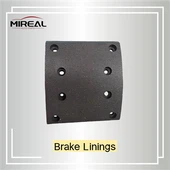
The transition of clutch friction materials from asbestos-based to asbestos-free has been driven primarily by health risks and environmental regulations; asbestos-free materials have now become the industry standard.
Asbestos-based materials were once widely used due to their low cost and excellent heat and wear resistance. However, asbestos fibers can be released into the air during wear; when inhaled, they may lead to serious health conditions, such as asbestosis and lung cancer. Beginning in the 1970s, developed nations in Europe and North America enacted legislation to phase out asbestos, with Europe implementing a total ban on asbestos-containing products in 2005. In China, the national standard for "Automotive Brake Linings" (GB 5763), first issued in 2003, explicitly prohibited the use of asbestos-a requirement that has been further reinforced in subsequent revisions of the standard.
There are two primary approaches to replacing asbestos: the first involves using metallic fibers to create "semi-metallic" or "low-metallic" friction materials; the second utilizes organic or inorganic fibers, such as aramid, glass, or ceramic fibers. Today, eco-friendly, asbestos-free materials-including those based on plant or synthetic fibers-have become the mainstream choice for clutch friction linings. The overarching industry trend favors lightweight, high-temperature resistant, and low-wear materials, while the rise of new energy vehicles has introduced even more stringent requirements for resistance to instantaneous torque shocks.
- Initial materials included cotton, cotton fabric, and leather; however, these lacked heat resistance and were prone to charring at high temperatures.
- In 1897, an asbestos-based friction material was invented in the UK. Offering an excellent balance of performance and cost, it became the industry standard, enabling clutches to transmit higher levels of torque.
- Following the confirmation of the health hazards associated with asbestos, Western nations began banning its production in the 1970s, compelling the industry to seek alternatives.
- Asbestos-Free Alternatives: Development in China began relatively late; it was not until 1989 that the country started introducing asbestos-free materials-primarily semi-metallic compounds-though these initially lagged behind those from developed nations in terms of both production volume and quality.
- Entering the 21st century, domestic enterprises ramped up research and development, leading to the widespread adoption of eco-friendly, asbestos-free materials (such as composite fibers and ceramic fibers). Globally, the market penetration of these alternative materials has risen from 65.8% in 2020 to 73.4% in 2025.
- Semi-metallic materials: The first materials to replace asbestos; they contain 30%–50% metallic fibers. While they offer good heat resistance, they tend to be noisy and cause significant wear on the pressure plate.
- These incorporate aramid, glass, or ceramic fibers, offering high toughness, low weight, and excellent high-temperature resistance.
- Known for exceptional high-temperature resistance and stable friction performance; typically used in high-performance vehicles or racing cars.
- Asbestos-free eco-friendly materials: These utilize plant or synthetic fibers to completely replace asbestos. They comply with environmental regulations and currently represent the mainstream choice in the market.